On this page
M6.9 Earthquake Strikes 35 km ENE of Kuji, Japan
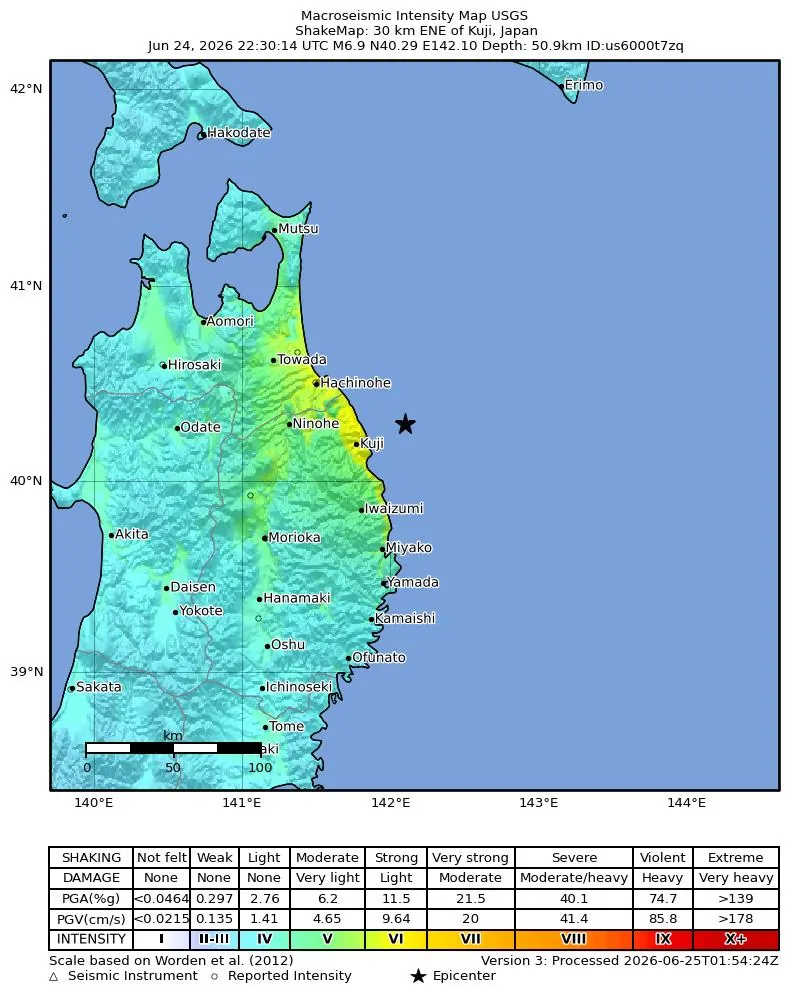
An earthquake with a magnitude of 6.9 struck 35 km ENE of Kuji, Japan, on June 24, 2026. The powerful seismic event occurred at a depth of 51.7 kilometers.
What Happened?
A magnitude 6.9 earthquake, categorized as an mww type, struck off the coast of Japan on June 24, 2026, at 22:30 UTC. The epicenter was located approximately 35 km ENE of Kuji, Japan, at coordinates 40.346°N latitude and 142.132°E longitude.
The seismic event originated at a depth of 51.7 kilometers. The United States Geological Survey (USGS) assigned a significant value of 748 to this event, indicating its potential for widespread impact.
Impact and Felt Reports
The earthquake generated a maximum Modified Mercalli Intensity (MMI) of 6.1. The Community Internet Intensity (CDI) was reported at 4.6, indicating moderate shaking in some areas.
A total of 34 individuals reported feeling the earthquake through the USGS 'Did You Feel It?' system. No specific details regarding casualties or damage are available at this time.
Tsunami Status
Authorities confirmed that no tsunami was generated by this magnitude 6.9 earthquake. This outcome is consistent with the event's characteristics and location.
For more information on tsunami preparedness, visit the National Tsunami Warning Center website.
Understanding Aftershocks
Aftershocks are common occurrences following a major earthquake. These smaller quakes can continue for days, weeks, or even months after the main seismic event, gradually decreasing in frequency and intensity.
The occurrence of aftershocks is a natural part of the Earth's crust adjusting to the redistribution of stress caused by the main shock. Residents in affected areas should remain vigilant and prepared for further seismic activity.
Tectonic Setting of Japan
Japan is situated in one of the most seismically active regions globally, known as the Pacific Ring of Fire. The country experiences frequent earthquakes due to the complex interaction of several major tectonic plates.
These include the Pacific Plate, which subducts beneath the Okhotsk Plate and the Philippine Sea Plate. This continuous plate movement and subduction zones are responsible for Japan's high earthquake and volcanic activity.
Understanding these geological processes is crucial for earthquake preparedness and mitigation efforts in the region. Learn more about the Earth's plates on our Plate Tectonics Explained page.
Earthquake Safety Guidelines
In the event of an earthquake, it is crucial to 'Drop, Cover, and Hold On.' Drop to the ground, take cover under a sturdy table or desk, and hold on until the shaking stops.
If you are outdoors, move to an open area away from buildings, trees, and power lines. For those driving, pull over to a clear spot and stay in your vehicle with your seatbelt fastened until the shaking ceases.
Having an emergency kit prepared, including water, non-perishable food, a first-aid kit, and essential documents, is highly recommended for all households in earthquake-prone regions. For more safety tips, visit our Earthquake Safety Guide.
Related Reading
Understanding Earthquake Magnitudes
Explore how earthquakes are measured and what different magnitudes mean for impact.
The Science Behind Tsunamis
Learn about the geological processes that lead to tsunami generation and their devastating effects.
Global Earthquake Activity Map
View recent earthquakes around the world on our interactive map.
FAQ
Frequently Asked Questions
What was the magnitude of this earthquake?
The earthquake had a magnitude of 6.9.
Where was the earthquake's epicenter located?
The epicenter was 35 km ENE of Kuji, Japan.
When did the earthquake occur?
The earthquake occurred on June 24, 2026, at 22:30 UTC.
Was a tsunami generated by this earthquake?
No, authorities confirmed that no tsunami was generated.
How deep was the earthquake?
The earthquake had a depth of 51.7 kilometers.
What was the highest intensity reported?
The maximum reported intensity was a Modified Mercalli Intensity (MMI) of 6.1.
Stay Informed and Prepared
Sign up for our newsletter to receive the latest earthquake news, safety tips, and preparedness guides directly to your inbox.