On this page
Earthquake Magnitude vs Intensity: What's the Difference?
Magnitude measures a quake's energy at the source; intensity measures what you feel. Learn the Mercalli scale with a real 1985 Mexico City example.
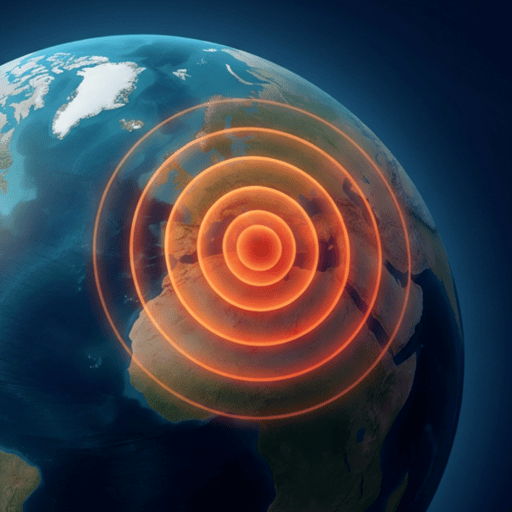
Magnitude: Energy at the Source
Magnitude is a single number that quantifies the energy released at the earthquake's hypocenter (the underground point of rupture). It is an objective, instrument-based measurement. A M6.5 earthquake releases the same total energy whether it occurs in a desert or beneath a dense city.
The modern standard is moment magnitude (Mw), based on seismic moment, a measurement derived from fault area, slip amount, and rock rigidity, the same fault-rupture process covered in our guide to how earthquakes happen. For the numbers themselves, read our full guide to earthquake magnitude scales.
Intensity: What You Actually Feel
Intensity describes the local effects of an earthquake, how strongly it is felt at a specific location, and what damage it causes there. Unlike magnitude (one number per earthquake), intensity varies from place to place and is expressed on scales like the Modified Mercalli Intensity (MMI) scale.
A single earthquake will have many different intensities across the affected area. The epicenter region typically experiences the highest intensity. Intensity decreases with distance, but can be locally amplified by soft soils, sedimentary basins, or steep terrain.
Magnitude comes from seismographs and is usually ready within minutes, calculated by the same USGS seismic network that feeds live earthquake maps. Intensity takes longer to pin down: agencies combine instrument readings, damage reports, and resident surveys like USGS's "Did You Feel It?" questionnaire, so a full intensity map for one earthquake can take hours to fill in as reports arrive place by place.
The Modified Mercalli Intensity Scale
| MMI | Description | What You Experience |
|---|---|---|
| I | Not felt | Only detected by instruments. |
| II, III | Weak | Felt by few, especially on upper floors. |
| IV | Light | Felt by many indoors. Hanging objects swing. |
| V | Moderate | Felt by nearly all. Doors open/close, liquids disturbed. |
| VI | Strong | Felt by all. Some minor structural damage. Difficult to stand. |
| VII | Very Strong | Damage in poorly built structures. Plaster cracks. |
| VIII | Severe | Major damage to ordinary structures. Chimneys fall. |
| IX | Violent | Severe damage. Bridges destroyed. Underground pipes broken. |
| X, XII | Extreme | Most structures collapse. Total destruction. Permanent ground deformation. |
Why the Same Quake Feels Different in Different Places
Four key factors determine local intensity for a given earthquake:
- Distance from epicenter: Seismic waves attenuate (weaken) with distance. Intensity generally decreases as you move further from the epicenter, though this is not always uniform.
- Earthquake depth: Shallow earthquakes (0-20 km deep) produce the most intense surface shaking for a given magnitude. Deep focus earthquakes (70-700+ km) affect much larger areas but feel weaker locally.
- Local site conditions: Soft sediments and clay amplify ground motion dramatically compared to hard bedrock. Mexico City and parts of Seattle, Oakland, and Christchurch are built on amplifying soils.
- Building quality: While not a seismological factor, building vulnerability determines whether intensity causes minor damage or complete collapse. Soft-story buildings and unreinforced masonry are particularly vulnerable.
A Practical Example: Mexico City and Distant Earthquakes
Mexico City is the clearest real-world proof that magnitude and intensity are two different things. The city sits on the drained bed of ancient Lake Texcoco, and that soft clay amplifies seismic waves 20 to 50 times compared to solid bedrock.
USGS records the September 19, 1985 Michoacán earthquake at magnitude Mw 8.0, 27.9 km deep, about 384 km from Mexico City on the Pacific coast (USGS event page). Coastal towns near the epicenter felt strong shaking, but few people lived there. Mexico City, sitting on the amplifying clay almost 400 km away, still suffered widespread building collapse in its historic center. Distance from the source did not protect the capital; the ground it stands on worked against it.
The same effect repeated on September 19, 2017, the anniversary of the 1985 quake to the day. A magnitude 7.1 earthquake struck about 119 km southeast of the city at 48 km depth (USGS event page). It was closer and mechanically different from 1985, but the damage again clustered in the same clay-basin neighborhoods, evidence that local geology, not distance from the epicenter, decides where a city gets hurt.
Related Reading
FAQ
Frequently Asked Questions
Can a low-magnitude earthquake have high intensity?
Yes. A M4.5 earthquake at 3 km depth directly beneath a city can cause strong shaking (intensity VII, VIII on the MMI scale). The same M4.5 at 50 km depth would be felt far less strongly. Depth and soil conditions dramatically affect intensity.
What is the Modified Mercalli Intensity (MMI) scale?
The MMI scale (I to XII) rates the effects of an earthquake as experienced by people and structures. I = not felt; IV = felt by most indoors; VI = felt by all, minor damage; VIII = serious damage to ordinary buildings; XII = total destruction. It provides a human-centered complement to magnitude.
Why does Mexico City shake so strongly from distant earthquakes?
Mexico City is built on the soft lacustrine clay of former Lake Texcoco. This clay layer acts like jelly, amplifying seismic waves 20-50 times compared to firm bedrock. A M8.0 earthquake 400 km away on the Pacific coast can cause intensity VIII shaking in the capital due to this site amplification effect.
How does Earthquake Globe use intensity data?
Earthquake Globe shows magnitude for all events. The app's notification descriptions include felt intensity estimates ("Felt: Moderate / Strong") based on depth and proximity, giving you practical context beyond the magnitude number alone.
What is the difference between peak ground acceleration and MMI?
Peak ground acceleration (PGA) is an engineering measure of how hard the ground shakes, expressed as a fraction of gravitational acceleration (g). MMI (Modified Mercalli Intensity) is a human-experience scale from I (not felt) to XII (total destruction). Both correlate but PGA is used in engineering calculations while MMI describes observed damage levels.
Track Earthquakes in Real Time
Free iPhone app. Every earthquake on a live 3D globe.